Learn how and when to remove grease from your appliances for cost-effective fire risk mitigation.
 Exhaust hood and duct cleaning is an essential service for commercial kitchens because it helps reduce the risk of fire in the exhaust system. At Flue Steam, we offer two different methods for exhaust hood cleaning: hand scraping and steam cleaning. Depending on your kitchen’s needs, we may need to use these cleaning techniques at different intervals in order to best promote fire safety in your kitchen.
Every 30 Days
In kitchens that prepare a high volume of grilled meats or fried foods, the exhaust hoods on cooking appliances need to be cleaned monthly by hand scraping. Typically, the main appliances that need to be cleaned include ranges, broilers, fryer vats. Depending on the layout of the kitchen, these appliances may have a shared exhaust hood or individual ones.
Every 90 Days
In kitchens that don’t focus so heavily on grease-producing foods and cooking methods, it may be sufficient to get hand scraping for ranges, broilers, and deep fryers much less frequently, perhaps even every 90 days. In other kitchens where hand scraping is occurring every 30 days, these same appliances will most likely need steam cleaning every 90 days.
Every Year
If might surprise you to learn that the exhaust hoods over non-grease creating appliances also need to be cleaned periodically. This includes appliances like steam kettles, soup vats, and even dishwashers. This is because even with proper ventilation hoods over all cooking equipment, minute amounts of greasy vapor still have the potential to escape and adhere to other surfaces. Typically cleaning these other exhaust hoods once per year is sufficient.
Find the Right Cleaning Schedule for Your Kitchen
Of course, the 30-day and 90-day guidelines are just starting points. Your particular kitchen may need more or less frequent cleaning. As long as you keep grease buildup within the level that is considered safe and remain in compliance with your local fire safety codes, you have the freedom to stray from the general guidelines.
At Flue Steam, we can help you establish a cost-effective schedule for your exhaust hood and duct cleaning needs. We do this by using a special industry-approved comb to measure grease deposits on interior hood and duct surfaces. This helps us establish the rate at which grease is being deposited which then determines the frequency at which it needs to be removed.
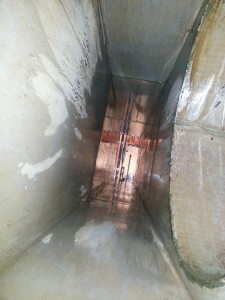 Every commercial kitchen needs periodic exhaust duct cleaning service. You may have many options for contractors to provide this service, but here at Flue Steam we believe we can provide superior service. Here are the top 5 benefits of working with us to keep your exhaust ducts clean using a combination of hand scraping and steam cleaning techniques.
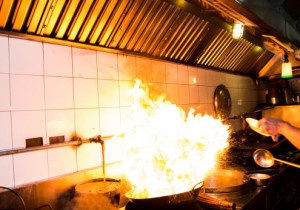 When cooking oil or grease from animal fat gets too hot, it will catch on fire. For vegetable oils, this will happen around 450°F, while lard and other animal fats will combust around 375°F. In a commercial kitchen, a fire on the cooktop is actually the least of your worries. The situation will be much more dangerous if the fire begins in or manages to spread to the interior of your exhaust hood or ductwork, as it can easily travel to other parts of the building from there.
 In any building, it is essential to maintain a balance in the air flowing in and out of different rooms in order to avoid creating negative pressure that interferes with comfort and energy efficiency. In most applications, balance can be achieved simply by installing air vents and return registers in every room. However, in the case of a commercial kitchen, this method does not work, because air that becomes hot and greasy from proximity to cooking surfaces cannot be safely or comfortably recirculated in the building. Instead, this air must be sucked into the kitchen exhaust system and vented from the building. For fresh, cool, new air, commercial kitchens must rely on makeup air handlers, typically in the form of a
 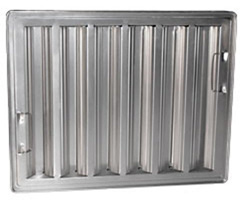 At Flue Steam, we offer a complete range of kitchen air control and fire suppression services to help protect your commercial kitchen from the risk of a fire. Selling quality grease filters is an important part of this effort. Here are some of the benefits of buying your grease filters from us.