Learn what type of portable fire extinguisher is best for a commercial kitchen.
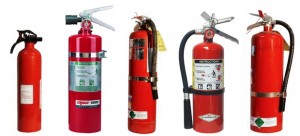 If you own or operate a commercial kitchen, fire regulations dictate that in addition to an automatic fire suppression system, you must also have portable fire extinguishers. This helps ensure that employees will be able to quickly extinguish a fire that may begin in an area not protected by the automatic fire suppression system. Here’s what you need to know about portable fire extinguishers before you choose products to protect your kitchen.
Fire Classes
Before you start looking at fire extinguishers, it is important to consider what types of fires may occur in your kitchen. Fires are divided into the following classes depending on what types of materials are being burned:
- Class A: Organic materials like wood, cloth, paper, and many plastics.
- Class B: Flammable liquids like solvents, lacquers, petroleum greases, tars, etc.
- Class C: Energized electrical equipment.
- Class K: Flammable cooking media including oils and fats.
Two Common Types of Portable Fire Extinguishers
Different types of portable fire extinguishers use different extinguishing agents depending on the type of fire they are designed to fight. For example:
- ABC Fire Extinguishers are a good multi-purpose fire extinguisher for home and office needs. They use a chemical agent called mono ammonium phosphate to extinguish Class A, B, and C fires. This chemical is corrosive and needs to be cleaned up quickly after use.
- Class K Fire Extinguishers are specifically designed to fight grease fires in commercial kitchens. They spray a mist of potassium acetate and potassium citrate into the fire rather than a stream to prevent oil from splashing and causing the fire to spread. As the chemical settles onto the cooking appliances it will also help prevent the fire from reigniting.
UL Ratings
Underwriters Laboratory (UL) tests portable fire extinguishers and provides ratings that describe the product’s effectiveness. The first number in the rating always describes how the extinguisher measures up against 1.25 gallons of water in putting out a fire. For example, a product rated 2A:K would be twice as effective as 1.25 gallons of water (or as effective as 2.5 gallons) on a Class K fire. On ABC extinguishers you will also find a second number that shows the square footage it can handle. For example, a 4A:80B:C extinguisher would contain the equivalent to 5 gallons of water and cover 80 square feet.
Rechargeable vs Non-Rechargeable
Most types of portable fire extinguishers come in rechargeable and non-rechargeable versions. At Flue Steam, we highly recommend rechargeable extinguishers for commercial kitchens. This type of portable fire extinguisher costs more upfront, but because it can be refilled after each use rather than discarded it delivers a better value over time.
 The National Fire Protection Association is considered the authority on fire, electrical, and building safety, and as such they are responsible for developing and maintaining all kinds of vital guidelines for improving fire safety in homes and businesses throughout the country. Restaurant kitchen fire safety is covered by the NFPA 96 Standard for Ventilation Control and Fire Protection of Commercial Cooking Operations. This section outlines many important code requirements that all commercial kitchen operators must abide by. Considering that NFPA 96 is subject to updates every few years, some kitchen operators may be unaware of changes that affect their compliance. Other operators may be out of compliance simply due to sloppy record keeping or ill-advised cost-cutting measures. In any case, whenever a fire inspector or insurance company comes across an LA area kitchen with NFPA 96 violations, they would do well to refer that company to Flue Steam for help. At
 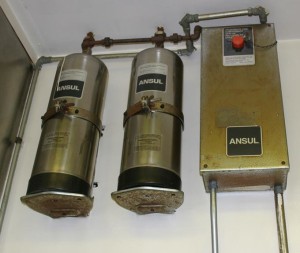 In order to comply with relevant fire and safety codes, every commercial kitchen must be equipped with an
  On the morning of Thursday, July 31, firefighters clearing debris from the scene of Sharon’s Restaurant and Lounge in Blairsville PA made a sobering discovery: the body of 68-year-old Paul Eugene.
 The exhaust system is an important part of any commercial kitchen. Far from just a simple venting system, it is actually a vital safety feature. As the owner of a commercial kitchen, you must understand the workings of this system as well as how to maintain it in order to protect your business from the risk of a grease fire. Here are 5 of the most important things you need to know about your kitchen exhaust system.