Blog

What Flue Steams’ IKECA Membership Means for Our Clients

July 21, 2014

IKECA membership signals compliance with the gold standard of kitchen exhaust cleaning practices.
IKECAThere are quite a lot of companies out there offering kitchen exhaust cleaning services. Unfortunately, not all of them are very reputable. They may not do a very good job, either unintentionally or deliberately, and because it is difficult to see every nook and cranny of your exhaust system, you may not realize that a shoddy cleaning has left your property at risk of a fire.

One excellent way to know you are working with a reputable company that provides quality services is to check for IKECA membership. IKECA stands for the International Kitchen Exhaust Cleaning Association. Membership in this trade organization signals that the company you’re about to hire is serious about their work. Flue Steam is proud to be an IKECA member because it enables our clients to rest assured as to the following key points.

Our Employees are Certified

As an IKECA member, Flue Steam employs individuals who have successfully completed IKECA courses related to kitchen exhaust cleaning and fire safety. This means that clients can rest assured our employees are fully trained and up to date on various tools and techniques involved in their work, as well as on local code requirements affecting kitchen exhaust systems.

We Follow Industry Best Practices

When you work with an IKECA company, you know that you are getting honest and accurate information about the best practices in kitchen exhaust system cleaning. In other words, you don’t have to wonder if you’re getting cleanings too seldom or too frequently, or if you’re having enough grease removed at each cleaning. We will provide all of this information to you based on our understanding of industry best practices as identified by IKECA.

We’re Dedicated to Ongoing Training

Many trade organizations award certifications for life. This is not true of IKECA. IKECA certifications must be kept up through the earning of continuing education credits, which can be acquired through attendance at various industry seminars and events. Because achieving and maintaining IKECA membership requires serious effort, it signals to our clients that we are dedicated to getting the latest training and education that will enable us to serve them better.

We Can Measure Our Work

One very helpful tool that IKECA puts out is a comb that can be used to measure the depth of grease buildups on exhaust hoods and duct walls. Using this comb, we can prove to you that our cleaning services have made a significant difference in the cleanliness of your exhaust system. We can also use data gathered from repeated use of the comb to estimate how fast grease builds up in your system and how frequently you need cleanings, to make sure you don’t waste money on cleanings before you need them or risk going too long between cleanings either.



Is Your Commercial Kitchen Ready for a Restaurant Inspection?

July 16, 2014

Flue Steam provides important services that help your kitchen pass the fire safety portion of a restaurant inspection.

InspectionAs the owner or operator of a commercial kitchen, you have countless regulations to comply with as to the condition of your facility, the behavior of your employees, and your food handling practices. With so many rules and requirements, the potential for surprise restaurant inspections by the health or fire authorities to result in a citation or even the temporary closure of your kitchen is very real. Fortunately, you can get expert help with the fire safety portion of a restaurant inspection from Flue Steam.
Here are the key areas that can trip up a restaurateur and result in a citation or failed inspection.

Facilities

The facilities of any restaurant need to be in a clean and sanitary condition. This includes the floor, ceiling, and walls of the dining area as well as the kitchen. Various amenities such as the employee restroom, the hot water, the plumbing in general, and the electricity also need to be in reliable working order. Plus, there are also additional requirements regarding the posting of menus with correct and accurate nutritional information.

Food Safety

It can take quite a lot of training to drum all the food safety requirements into your employees’ heads. Some requirements, like washing hands before and after handling raw meats and not cross contaminating surfaces, utensils, and containers with different raw meat products are common sense. Others, like not storing raw foods above ready to eat foods, are a little harder to remember because they aren’t something people worry about in private kitchens.

Fire Safety

In a commercial kitchen, there is a significant risk of fire associate with all the cooking that goes on, especially if lots of foods are fried, grilled, or otherwise prepared in a way that tends to release a lot of greasy vapor. Commercial kitchens are required to take certain steps to guard against the risk of fire in general and grease fires in particular. Flue Steam can help with many of these activities.

For example, we can ensure that your kitchen exhaust hoods remain free of dangerous amounts of grease buildup with hand scraping services. We can also help remove grease deposits that may have migrated further into the exhaust ducts with steam cleaning services. For maximum efficiency, we recommend hand scraping every month or so, supplemented by steam cleaning several times per year, depending on how much greasy food you cook in the kitchen.

Flue Steam can also install and service fire extinguishers and automatic fire suppression systems. We provide dated stickers each time we service these kinds of equipment to make it easy for you to prove that you’ve fulfilled your fire suppression obligations during a visit from the fire inspector.

Call Flue Steam today to schedule service, and help improve your chances of passing your next fire inspection with flying colors.

Turning a Restaurant Fire into an Opportunity

June 23, 2014

How you present your restaurant after a fire can have big impact on your success.

OpportunityAfter a kitchen fire that causes enough damage to close your restaurant, you will have many obstacles to overcome on the way to reopening. In addition to repairing smoke and fire damage, you may also have to deal with water damage created when firefighters put out your fire. You’ll also have to deal with the impact of the fire on your brand and convince your customers to come back. However, the impact of a fire doesn’t have to be all negative. It can also provide opportunities for improvements that will benefit your business. Here are some examples.
Interior Design Updates

Assuming the fire is ruled accidental, you will surely get some insurance money to spend on your repairs. Why not augment those funds with some of your own and get a really awesome update to your restaurant furniture and décor? Depending on the extent of the damage, you may have an opportunity to change more than just carpeting and furnishings—you may even be able to redesign the kitchen or dining room to make it more attractive or more functional.

New Cooking Equipment

Another upside of a fire could be the chance to get new cooking equipment. This includes new exhaust hoods to go with the new ovens, ranges, fryers, etc. The latest generation of exhaust hoods come with some pretty impressive technology that will give you better control and oversight over their cleanliness.

Kitchen Air Flow Reassessment

When installing new cooking equipment or making changes to your kitchen layout and design, be sure to consider the effect this will have on your kitchen air flow. You may take this opportunity to get your air flow reassessed and purchase new exhaust fans or swamp coolers as needed.

Fire Prevention Improvements

Assuming the fire was linked to greasy exhaust hoods or ducts, you should definitely consider improvements in your fire prevention protocols. For example, you might want to increase the frequency of your exhaust hood scrapings or exhaust duct steam cleanings to help prevent grease from building up to dangerous levels again. You might also consider having new access panels cut into your ductwork to make it easier for every inch of the system to get clean, and you will certainly have to have your automatic fire prevention system reset and your portable fire extinguishers refilled or replaced.

Marketing Opportunities

Finally, don’t neglect to make an effort to turn the negative publicity surrounding your restaurant closure into positive publicity when you reopen. You might consider adding new items to the menu or planning a special grand reopening where you invite some of your most loyal customers.

Preventing Restaurant Fires

June 19, 2014

Don’t let your restaurant make the news due to fire—get help from Flue Steam now.

Preventing FiresAt Flue Steam, we are constantly advocating for all restaurateurs to invest in comprehensive fire prevention services, including regular kitchen exhaust system cleanings and regular maintenance for code compliant automatic fire suppression systems. Getting behind in either of these activities can have an extremely negative impact on your business, as the following news items show.
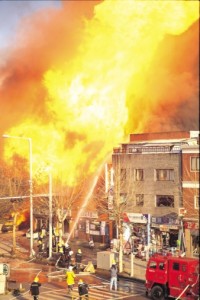
Near the end of May, a Macaroni Grill located in Alexandria, Virginia caught fire and suffered over $300,000 in damages. The fire was noted at 2:45 am, a time when the restaurant was closed and empty, making it hard to say exactly why fire the fire started. What is clear is that the fire was centered inside a kitchen exhaust duct above a pizza oven, and then spread through the ductwork and burned the ceiling and roof area. Officials have concluded that the fire was an accident and that grease in the ductwork was the main fuel. This case serves to highlight the fact that restaurant owners don’t just have to worry about fires while cooking is actually going on. If grease is allowed to accumulate in the ducts, it can serve as fuel for any kind of fire, such as one caused by an electrical problem or even an arson fire.

Another news item comes from Pittsburgh, where a pair of restaurants are just now preparing to reopen after a four alarm fire gutted them in February. While the cause of the fire has not been disclosed, we can get a major clue from the facts that A) the fire was ruled accidental by the insurance company and B) the restaurant manager was especially excited to announce that improvements in kitchen safety have been incorporated into the newly renovated restaurants. Specifically, the management mentioned that they have a new oven with a CaptiveAire CORE hood featuring the most advanced kitchen safety technology available, including a “self-cleaning system that scrubs itself daily.” From these facts it would not be unreasonable to conclude that some kind of accidental grease fire was responsible for the original damage to the restaurants.

Protect Your Commercial Kitchen with Help from Flue Steam

If you want to protect your commercial kitchen from fire risks, you need to remember 3 things. First of all, installing quality kitchen exhaust system equipment can help limit risk of fires. Secondly, this equipment needs to be cleaned regularly in order to do its job. Thirdly, in the event that a fire does start in the kitchen, you need a first line of defense against that fire spreading, which can easily be provided by an automatic fire suppression system.

At Flue Steam, we offer all the assistance you need to limit fire hazards in your kitchen. We provide hand scraping of kitchen exhaust hoods as well as steam cleaning of ductwork and service for automatic fire suppression systems.

US Leads the Industrialized World in Fire Deaths

May 24, 2014

Don’t let a fire at your restaurant contribute to this statistic.

Fire DeathsAccording to a recent FEMA report, the US leads the industrialized world in deaths caused by fires, with 30 to 50 percent more deaths than many countries and three times as many deaths as in Switzerland or The Netherlands. Why? According to the report, the main reason could be that the US emphasizes fire suppression over fire prevention, and it turns out that prevention may be more effective in saving lives.
Suppression vs Prevention

In the US, we spend most of our money and effort on ensuring a rapid response to fires. In other countries, a significant chunk of funds are also directed towards educating the public about fire prevention and enforcing regulations designed to prevent fires or limit their spread. This is why The Netherlands, which has a 30-minute response time to fires, has fewer fire deaths than the US, where a 30-minute response time would have the community up in arms. In countries where prevention is emphasized, people are apparently able to get out of harm’s way faster.

Conflicting Fire Codes

Another problem that could be contributing to the high rate of fire deaths in America is the fact that we lack a single overarching fire code as is seen in many other countries. Instead, fire codes are left to individual cities and municipalities. The result is that fire prevention efforts vary widely from one part of the country to another. This is beneficial in some ways, because local agencies are better equipped to respond to the needs of the citizens and businesses in their region. However, it can also result in a lackadaisical attitude towards regulation.

California Commercial Kitchen Fire Codes

One area of American life where fire prevention is heavily stressed through government regulation is in commercial kitchens. All commercial kitchens are expected to have approved fire prevention and suppression systems in place. For example, commercial kitchens must have adequate exhaust systems that can effectively remove smoky, greasy air from the kitchen. They are also required to invest in regular exhaust hood and duct cleanings to prevent greasy residue from accumulating to unsafe levels and creating a fire hazard. Plus, commercial kitchens must have an automatic fire suppression system in place as a back up to quickly extinguish a fire should the aforementioned fire prevention tactics fail.

If you own or operate a commercial kitchen in the LA area, Flue Steam can help you keep up with your fire code obligations and reduce the risk of a fire in your exhaust system claiming the lives of any of your employees or guests.